How do you define 'original' in an era of endless remixing? For years, Instagram was the land of the aggregator. Theme accounts, 'curators,' and brands alike built massive followings by simply being the best filter for existing content. That era is officially over. Instagram has implemented a structural shift in how its recommendation engine treats duplicate media, moving from a neutral stance to an active penalty system. If you've noticed your reach cratering while your engagement-to-follower ratio remains steady, you aren't being shadowbanned—you're likely being flagged as an aggregator.
Why it matters: This update isn't just a slap on the wrist for meme pages; it changes the fundamental math of ROI for social teams. Repurposing assets across platforms or using user-generated content (UGC) now requires a specific technical workflow to avoid being buried in the feed.
TL;DR
- The Mechanism: Instagram now uses fingerprinting to identify the 'original' uploader. Subsequent uploads of the same file are suppressed in recommendations.
- The Threshold: Accounts that post more than 10 pieces of duplicate content in a rolling 30-day window are ineligible for the Explore page and Reels tab.
- The Fix: Brands must shift from simple reposting to 'transformative' curation, adding significant creative value through editing, voiceover, or unique commentary.
The fingerprinting mechanism: How Instagram knows you're reposting
To understand the crackdown, you have to understand the technology. Instagram doesn't just look at the pixels; it looks at the digital DNA of the file. Every video uploaded to the platform is assigned a unique hash—a mathematical signature that identifies that specific arrangement of data. When you download a Reel from TikTok or save a video from a partner's feed and re-upload it, the hash remains largely the same.
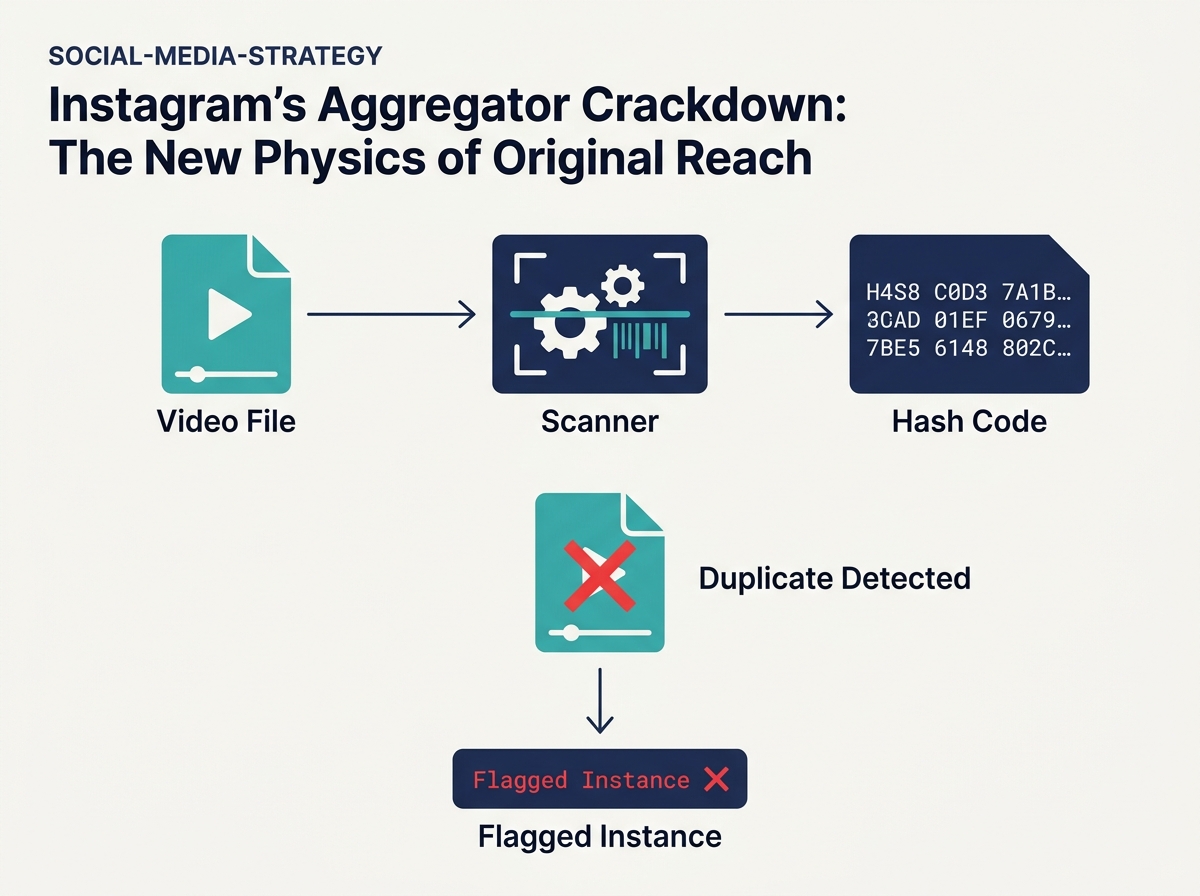
Since the rollout of the 2024-2025 algorithm adjustments, Instagram's system now cross-references every new upload against a massive database of existing hashes. If a match is found, the system checks the timestamp. The earliest uploader is crowned the 'Original Creator.' Every subsequent uploader is tagged as a 'reposter.'
This isn't just about copyright; it's about the user experience. Instagram's internal data—per the platform's Q3 2025 engineering blog—showed that users were seeing the same viral clips 5-7 times in a single session. This redundancy led to 'scroll fatigue' and a measurable drop in time-spent-on-app. By penalizing duplicates, Instagram is forcing variety back into the feed. For you, the marketer, this means that even if you have the rights to a piece of content (like a testimonial from a customer), being the second person to post it could kill its reach.
The 30-day rolling penalty: Why consistency in 'originality' is the new KPI
Instagram has introduced a specific 'aggregator' status that is applied at the account level, not just the post level. Based on current platform documentation, if an account posts 'unoriginal content'—defined as content that the account did not create or enhance in a significant way—more than 10 times in 30 days, the entire account is removed from recommendation surfaces.
This is a nuclear option. Being removed from recommendations means your content will only be shown to people who already follow you. Your ability to acquire new followers through the Reels tab or the Explore page effectively hits zero.
How to audit your account for recommendation eligibility
This penalty isn't permanent, but it is punishing. Once you fall under the threshold of 10 duplicate posts in a 30-day window, you have to wait another 30 days for the flag to clear. For a brand running a high-frequency posting schedule, a single month of 'lazy' curation can derail a quarterly growth target. We've seen agency partners report a 90% drop in non-follower reach within 48 hours of hitting this threshold.
Transformative vs. Duplicate: Where the line is drawn
One of the most common questions from social media managers is: 'Does this mean I can't post UGC?' The answer is no, but you can't post it as-is. Instagram has carved out an exception for 'transformative' content. This is where the strategy shifts from aggregation to true curation.
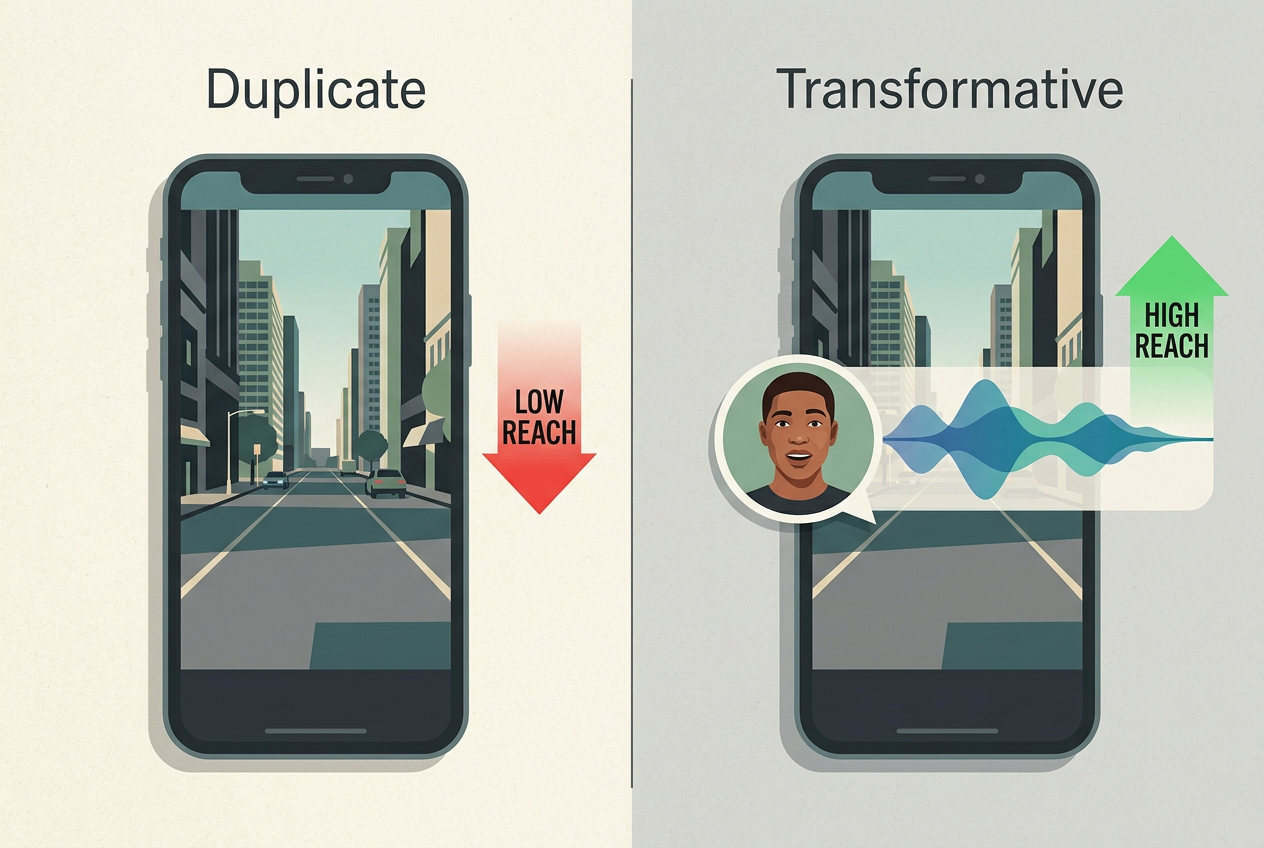
To be considered transformative, the new post must add significant value that didn't exist in the original. This isn't just adding a text overlay or a brand logo in the corner. Instagram's AI now looks for:
- Voiceover and Narration: Adding your own perspective or analysis via audio.
- Split-Screen or Green Screen: Reacting to or building upon the original video.
- Heavy Editing: Cutting the original footage into a new sequence, adding significant new visual elements, or mixing it with original B-roll.
- Meaningful Captions: While the caption doesn't change the hash, it changes the metadata context, though this is the weakest signal for avoiding the penalty.
If you are a brand that relies on influencer content, you should no longer simply 'repost' their video. Instead, use the 'Collab' feature. The Collab feature allows the post to live on both profiles simultaneously, sharing the same engagement and, crucially, identifying both as 'owners' of the original hash. This bypasses the duplicate penalty entirely because the system views it as a single distribution event rather than a copy.
The 'Originality' workflow: A checklist for 2026
As we look at the landscape in early 2026, social teams need to bake originality into their standard operating procedures (SOPs). The days of the 'repost and tag' strategy are dead. Even major players are feeling the heat; following the ownership volatility at X and the continued regulatory pressure on TikTok (as reported by Digiday in January 2026), Instagram is positioning itself as the 'premium' original content destination.

To maintain your reach, follow this workflow for every piece of content that didn't originate in your own camera roll:
- Check for existing hashes: Has this video already gone viral? If it has 1M+ views on another account, the hash is already 'hot' in Instagram's database. You must transform it significantly.
- Prioritize the Collab tool: If you're working with a creator, make the Collab invite a non-negotiable part of the contract. It is the only 100% safe way to share content.
- Add the 'Brand Layer': If you must repost, add a unique intro or outro. Use your brand's unique voiceover. Ensure the first 3 seconds of the video are entirely original to your account.
- Monitor Account Status: Regularly check 'Account Status' in your professional dashboard. Instagram will actually tell you if you've been flagged for unoriginality, though they won't always tell you which post triggered it.
Beyond the algorithm: The rise of 'Human-Centric' signals
There is a deeper trend at play here. As AI-generated content becomes more prevalent—with tools like Claude now able to clone entire web architectures in minutes (as discussed in recent digital marketing circles)—platforms are over-correcting toward 'human' signals. Instagram's crackdown on aggregators is a proxy for a crackdown on low-effort AI mass-production.
[INTERNAL: The impact of AI-generated video on social reach -> ai-video-strategy-2026]
They want to see the 'jitter' of a real camera, the unique cadence of a human voice, and the specific creative choices that a bot (or a lazy curator) wouldn't make. This is why we're seeing a resurgence in 'lo-fi' content. A raw, original video shot on an iPhone often out-performs a highly polished, but technically 'duplicate' asset from a global campaign.
What this means for your strategy tomorrow
If you are managing a brand account today, your first move is to audit your last 30 days of posts. Count how many times you used a video file that was not recorded by your team or sent to you as an original file from a creator. If that number is nearing 10, you are in the danger zone.
Stop the 'curation' immediately and pivot to original 'talking head' videos or behind-the-scenes content to dilute the ratio. The goal is to keep your 'Originality Score' high enough that the recommendation engine continues to work for you, not against you. In the new Instagram economy, the most valuable asset isn't your follower count—it's your status as an 'Original Creator' in the eyes of the machine.
Ultimately, this update is a gift to brands with real creative resources and a curse for those who have relied on the 'media company' model of aggregation. By leaning into original production and using the Collab tool strategically, you can capture the reach that the aggregators are currently losing. The audience hasn't left; they're just being redirected to those who actually have something new to show them.
FAQ