
If you are still using Large Language Models (LLMs) exclusively to brainstorm captions or rewrite emails, you are operating in the 2023 era of marketing. The shift in 2026 isn't about better prose; it is about agency. We have moved from 'Chat' interfaces to 'Agent' environments—software that doesn't just suggest a strategy but executes the technical deployment across your stack.
Why it matters: As platform volatility increases—evidenced by the ongoing TikTok ownership saga reported by Digiday in early 2026—marketers need tools that can pivot entire web environments and ad campaigns in minutes, not weeks. The goal is no longer content production; it is infrastructure agility.
Key takeaways
- Agentic Shift: Tools like Claude now handle technical tasks like cloning and deploying web environments, reducing reliance on external developers.
- Platform Integration: New acquisitions, such as Youxin Technology’s $10.8 million stake in YATOP, signal a move toward deeply integrated, AI-driven TikTok automation.
- Moderation Risks: Automated systems remain flawed; recent Instagram moderation errors highlight the need for human oversight in AI-driven community management.
- Workflow Consolidation: The most effective AI stacks in 2026 are those that bridge the gap between creative generation and technical deployment.
1. Claude 3.5 Sonnet: The Infrastructure Architect
Claude has transitioned from a creative writing assistant to a technical co-pilot for the modern social media manager. While ChatGPT remains a dominant force in general-purpose chat, Claude’s specific advantage lies in its ability to handle complex, multi-file code environments and execute deployment tasks. For a social media manager, this means the ability to create bespoke landing pages for specific campaigns without waiting for the dev team's sprint cycle.
Per recent user reports in the digital marketing community in May 2026, marketers are using Claude to clone existing Webflow sites and deploy production-ready versions onto Vercel in under ten minutes. This isn't just about saving money on freelancers; it's about speed-to-market. If a trend breaks on TikTok at 10:00 AM, an agentic workflow allows you to have a dedicated, high-converting landing page live by 10:15 AM.
Claude’s 'Artifacts' UI allows you to see the code and the live preview side-by-side, making it the premier tool for marketers who need to bridge the gap between social content and web conversion. It handles the 'agentic' heavy lifting of environment configuration that previously required a mid-level engineer.
Best for: SMMs who need to build and deploy campaign-specific landing pages or custom web tools without a developer.
2. YATOP: The TikTok Performance Engine
As TikTok faces continued scrutiny and potential ownership shifts in 2026, the demand for sophisticated, programmatic ad management has spiked. YATOP has emerged as a critical player in this space, recently drawing a $10.8 million investment from Youxin Technology for an 18% stake in April 2026. This move highlights the growing value of TikTok Marketing Partners that can automate the 'boring' parts of performance marketing.
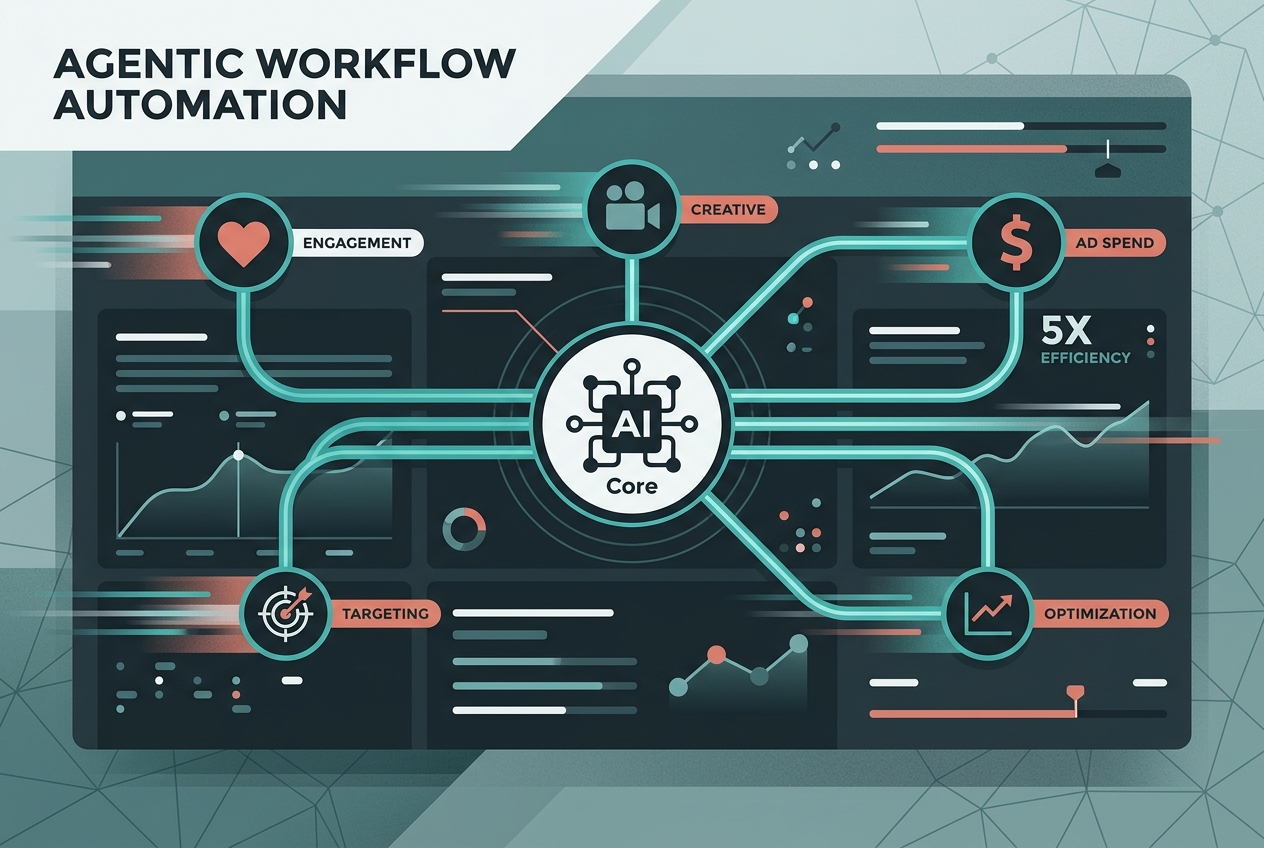
YATOP doesn't just suggest ad creative; it uses agentic AI to monitor real-time performance metrics and adjust bidding strategies, creative rotation, and audience targeting without manual intervention. For agencies managing high-volume spend, this level of automation is the only way to maintain ROI as the platform's algorithm becomes more volatile.
Unlike standard ad managers, YATOP’s integration allows it to pull from a brand's organic trending content and immediately convert high-performing clips into Spark Ads. It functions as a bridge between the creative desk and the media buying desk, ensuring that the distance between a 'viral moment' and a 'conversion event' is as short as possible.
Best for: High-spend performance marketers and agencies focused on TikTok ROI and automated scaling.
3. Brandwatch with Agentic Insights
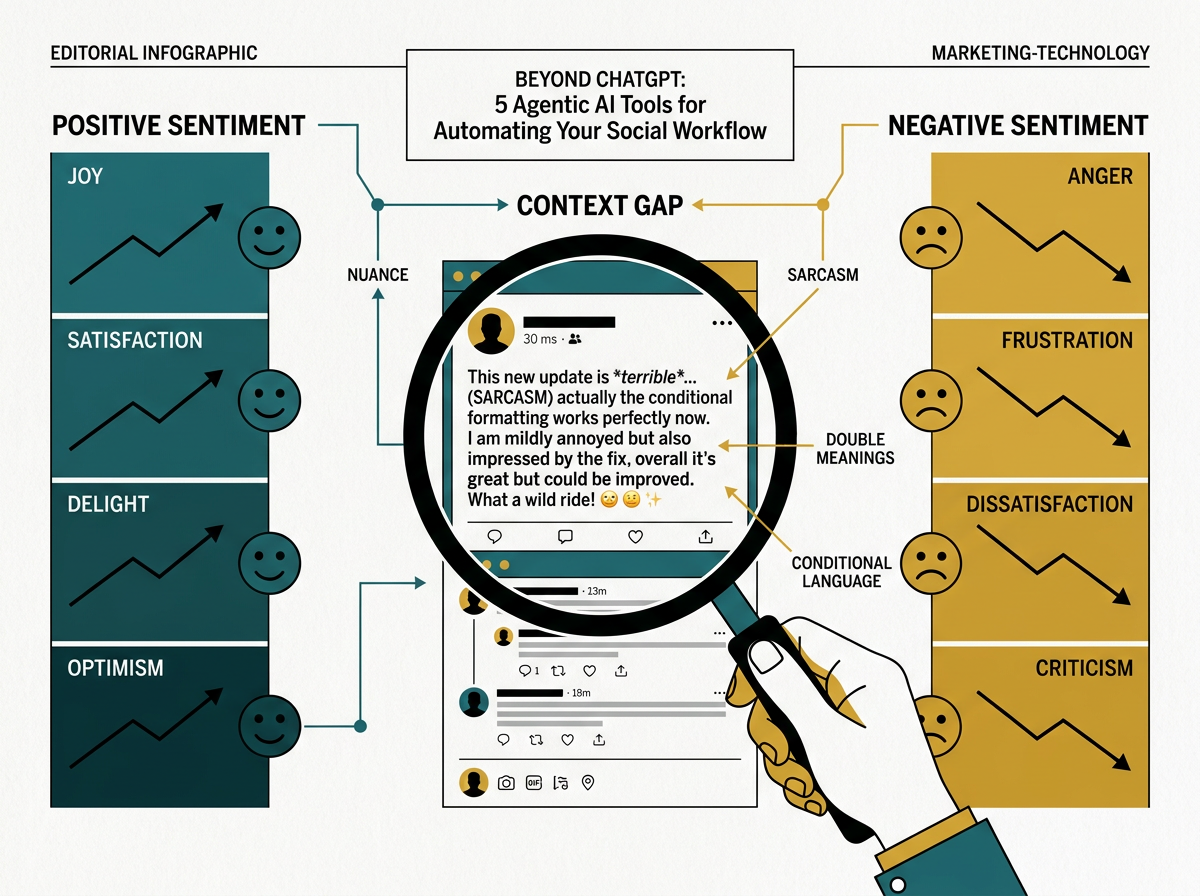
Social listening has evolved from simple keyword tracking to predictive sentiment modeling. Brandwatch has integrated agentic workflows that don't just alert you when your brand is mentioned—they categorize the intent behind the mention and suggest a multi-platform response strategy.
Following the August 2024 deprecation of Meta's CrowdTangle, the industry saw a vacuum in real-time data accessibility. Brandwatch and similar enterprise tools have filled this gap by using AI to synthesize data across fragmented platforms, including X, Reddit, and decentralized social networks.
In 2026, the agentic component of Brandwatch allows it to automatically draft community management responses based on a brand's specific 'voice' guidelines. However, a word of caution: automated moderation is still a blunt instrument. Recent incidents on Instagram, where sentimental content (like a video of a deceased relative) was erroneously flagged as 'sexual activity,' serve as a grim reminder that AI agents lack the human context required for sensitive community management.
Best for: Enterprise brands requiring deep sentiment analysis and automated (but human-verified) community management.
4. Zapier Central: The Workflow Glue
If Claude is the architect and YATOP is the engine, Zapier Central is the nervous system. Zapier has moved beyond simple 'If This, Then That' triggers into a space where you can train AI bots on your specific business data. These bots act as agents that can interact with over 6,000 apps.
For a social media workflow, this means you can create a bot that monitors your Shopify store for new product launches, automatically pulls product images, sends them to an image-generation tool for social formatting, drafts a caption in your brand voice, and queues it in your scheduler.
This is the 'full-scale deployment' marketers have been promised for years. By training the bot on your specific brand guidelines and historical performance data, you move away from generic AI output. The bot 'knows' that your Instagram audience prefers technical specs while your TikTok audience wants humor. It doesn't just move data; it interprets it according to your strategy.
Best for: Solo-marketers and small teams who need to replicate the output of a full-scale agency through deep automation.
5. Runway Gen-3: Automated Video Iteration
Video is the non-negotiable currency of 2026 social media. Runway Gen-3 has introduced agentic features that allow marketers to upload a single 'hero' video and automatically generate dozens of variations—changing the background, the lighting, or even the product being featured—to suit different audience segments.
This level of automation solves the primary bottleneck in social media: creative fatigue. Instead of filming five different ads, you film one and let the AI agent handle the localization and A/B testing variations. According to internal benchmarks from several mid-sized agencies in early 2026, this approach has reduced video production costs by up to 40% while increasing the volume of creative assets available for testing.
When combined with a tool like YATOP, the workflow becomes a closed loop: Runway generates the creative, YATOP tests it, and the performance data is fed back into Runway to inform the next batch of automated edits. This is the definition of a modern, agentic marketing stack.
Best for: Content creators and brands that need to produce high volumes of short-form video for multi-platform testing.
The Strategic Shift from Creation to Curation
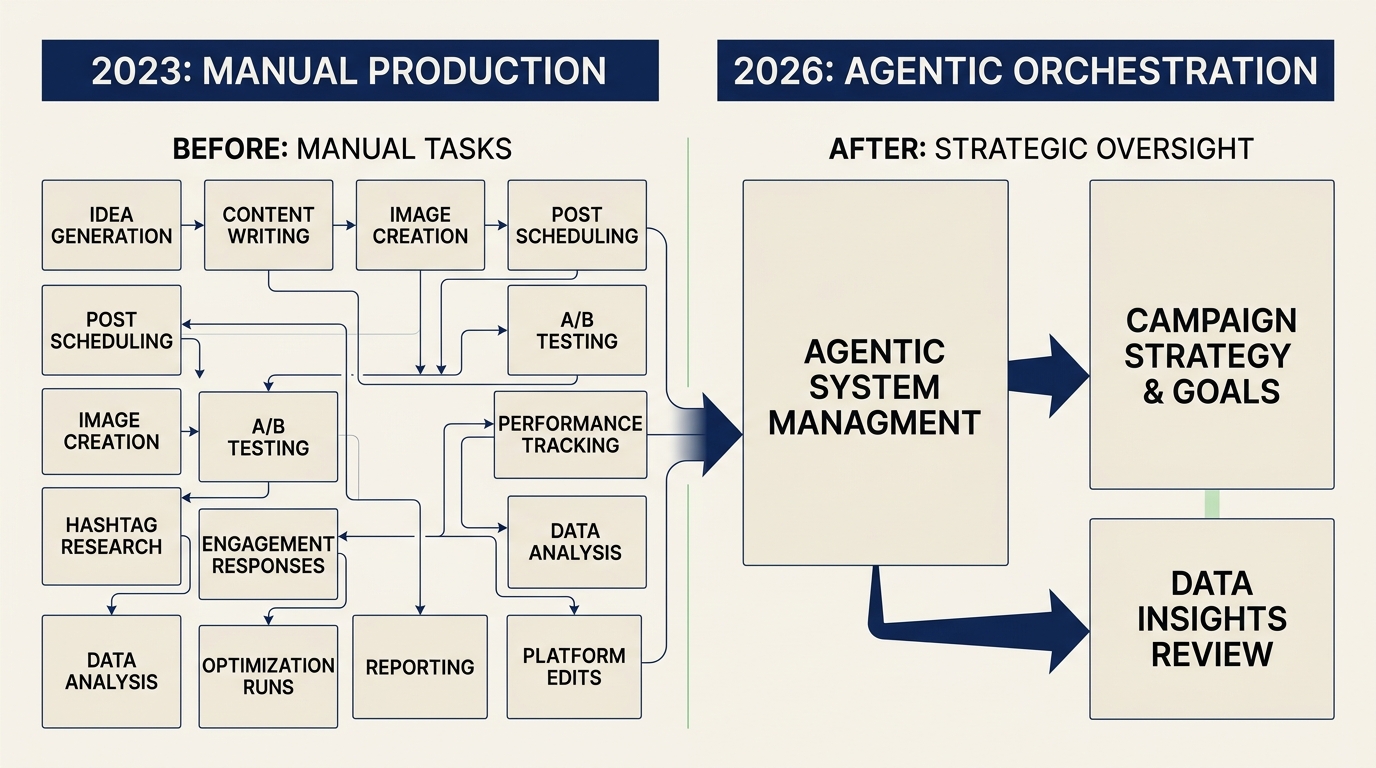
The common thread across these tools is the reduction of 'friction' between an idea and its execution. In the traditional workflow, a social media manager would spend 60% of their time on production—writing, editing, and technical setup—and only 40% on strategy. Agentic AI flips this ratio.
You are no longer the one pulling the levers; you are the one designing the machine that pulls the levers. This requires a shift in skillset. Marketers must move from being 'content creators' to 'system designers.' You need to understand how to prompt Claude for a technical deployment, how to audit a YATOP automated bidding strategy, and how to intervene when a Brandwatch agent misinterprets a sensitive community interaction.
As we look toward the second half of 2026, the competitive advantage will not go to the brand with the best AI-written captions. It will go to the brand that has built the most resilient, automated infrastructure—one that can survive platform bans, ownership changes, and algorithm shifts with minimal human downtime.
How to Audit Your Current Workflow for Agency
To move toward an agentic model, start by identifying the repetitive technical tasks that currently slow your team down. Are you waiting on IT for tracking pixels? Are you manually resizing videos for five different platforms? These are the first areas where an agentic tool like Claude or Runway should be applied.
- Map the Hand-offs: Every time a project moves from one person to another (e.g., from the copywriter to the designer), there is a delay. Aim to use AI to handle these transitional steps.
- Test in Sandboxes: Before letting an AI agent handle live customer responses or ad spend, test it in a controlled environment. Use Claude to build a 'staging' version of a site before pushing to production.
- Prioritize Integration: A tool that doesn't talk to the rest of your stack is just another silo. Prioritize tools with robust API access or those that live within the Zapier ecosystem.
The goal is a workflow where the human provides the 'Why' and the 'Who,' while the AI agent handles the 'How' and the 'Where.' Those who master this division of labor will define the next era of digital marketing.
FAQ