The era of the 'unhinged' brand mascot—the chaotic, shit-posting, HR-defying entity that defined the early 2020s—is officially entering its twilight. Duolingo, the undisputed pioneer of this high-risk, high-reward strategy, has begun a quiet but deliberate retreat toward structured utility. This shift isn't a failure of creativity; it's a calculated response to a social landscape where shock value has reached a point of diminishing returns and brand safety is once again a boardroom priority.
The peak of the 'Unhinged' era and its inevitable decline
For three years, the playbook was simple: act like a person, not a corporation. If you could make it look like your social media manager was having a breakdown or, better yet, that your mascot was stalking a pop star, the engagement followed. Duolingo’s Duo the Owl became the gold standard, racking up millions of followers by threatening users to do their Spanish lessons and thirsting after Dua Lipa.
But the 'unhinged' strategy was always a debt-based economy. You borrow attention from the culture by breaking norms, but eventually, the norms adapt, and the interest rates rise. According to internal agency benchmarks from late 2024, the engagement-to-conversion ratio for purely 'chaotic' content has dropped by nearly 30% year-over-year. Practitioners are realizing that while a viral video of a mascot doing a TikTok dance in a dumpster gets views, it doesn't necessarily sell language subscriptions or SaaS seats.
We've reached peak saturation. When every brand from your local insurance agent to a multi-billion dollar airline is trying to be 'savage' in the comments, the novelty evaporates. What was once a bold subversion of corporate professionalism has become its own tired cliché. How brand voice fatigue impacts follower retention
Why brand safety is reclaiming the driver's seat
The pivot away from chaos isn't just about boredom; it's about risk. In the current climate, the line between 'edgy' and 'offensive' is razor-thin, and the platforms themselves are becoming increasingly unpredictable. Recent reports from Digiday [S4] highlight how marketers are bracing for 'TikTok whiplash' in 2026, driven by ownership disputes and regulatory pressure. In an environment where a platform's very existence is questioned, brands can't afford to have their primary asset be a liability.
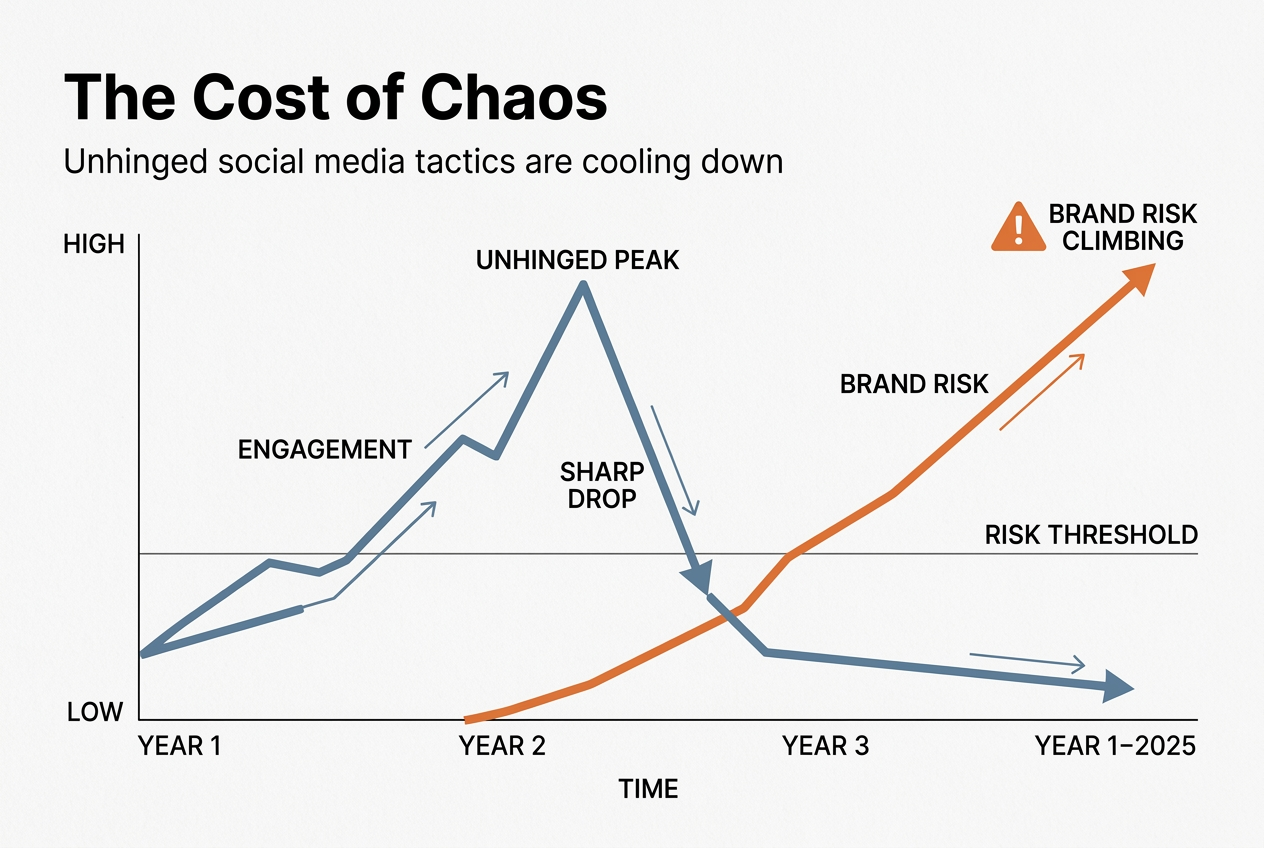
Consider the recent backlash faced by several mid-tier consumer brands that attempted to replicate Duolingo's snark. Without the years of context and the specific 'Duo' persona, these attempts often landed as mean-spirited or tone-deaf. For a staffer at a Fortune 500 company, the 'unhinged' approach is a career gamble that no longer offers a guaranteed payout.
Furthermore, the automated moderation systems on platforms like Instagram and TikTok are becoming both more aggressive and more erratic. A recent viral story [S3] regarding Instagram's removal of legacy content for false 'nudity' flags illustrates the fragility of brand presence. If a platform's AI can't distinguish between a memorial video and a policy violation, it certainly won't appreciate the nuance of a brand 'ironically' breaking rules for clout.
The return to high-utility and structured content
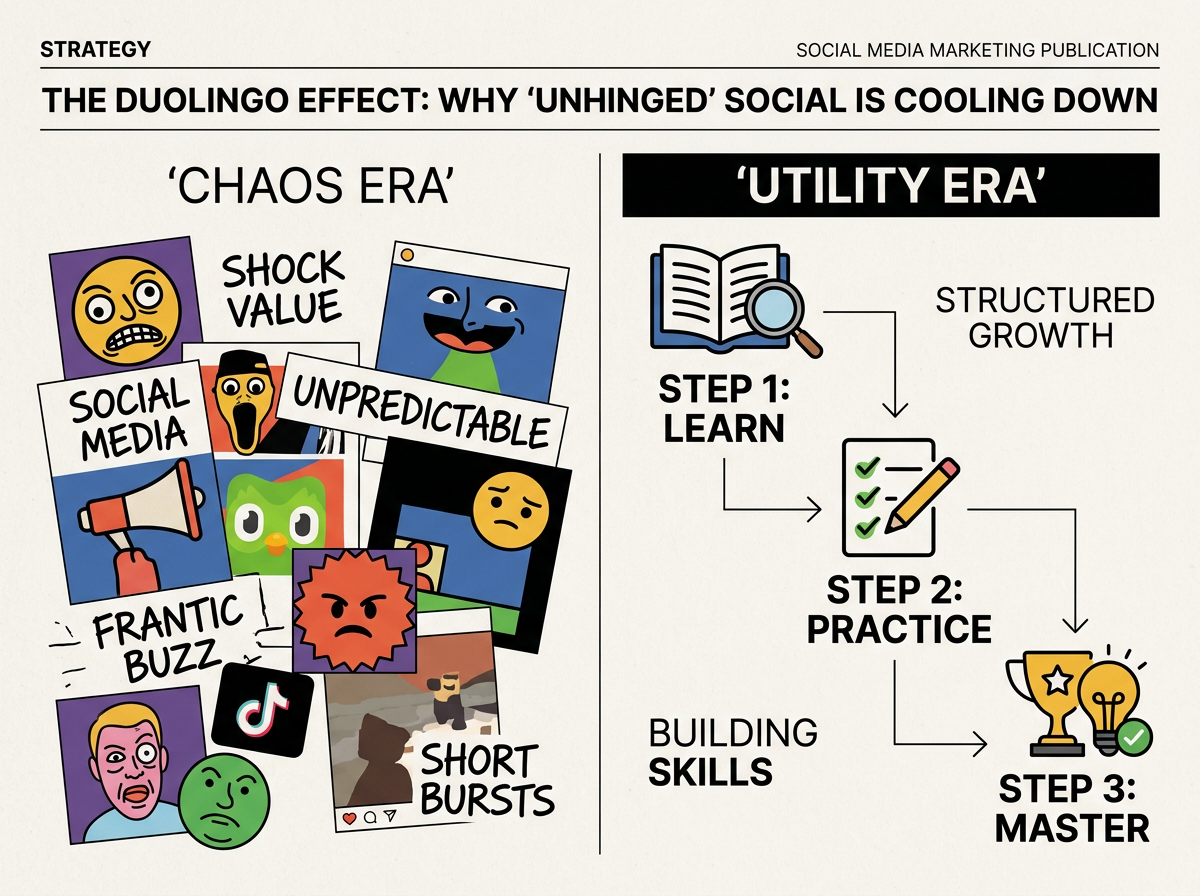
So, what replaces the chaos? The answer is utility. We are seeing a massive swing back toward content that actually helps the user. Instead of Duo the Owl twerking, we’re seeing more content focused on 'How to actually learn a language in 10 minutes a day.'
This isn't a return to the boring corporate whitepapers of 2012. It’s 'Utility 2.0.' This means:
- Educational Entertainment: Content that teaches a specific skill using the fast-paced editing style of modern social.
- Community-Led Growth: Leveraging real users and creators rather than a single mascot.
- Transparent Product Integration: Showing the product in use without the layers of irony.
Investment is following this trend. Look at the recent acquisition activity in the space. Youxin Technology’s $10.8 million stake in TikTok partner YATOP [S2] suggests that the smart money is moving toward infrastructure and performance-based marketing rather than just 'viral' potential.
Marketers are also turning to agentic AI tools to handle the heavy lifting of content creation. As noted in recent industry discussions [S5], tools like Claude are allowing small teams to deploy production-grade landing pages and structured content funnels in minutes. When you can iterate on utility-based content this quickly, the need to 'go viral' with a stunt becomes less pressing.
The counterargument: Is 'boring' a death sentence?
The strongest critique of this shift is that brands will simply become invisible again. Critics argue that by pulling back on the 'unhinged' reins, Duolingo and its peers are surrendering the only thing that made them relevant in a crowded feed: personality. They fear a return to the 'Happy Monday!' posts that everyone ignored.
However, this assumes that 'personality' and 'chaos' are the same thing. They aren't. A brand can be witty, sharp, and human without being a liability. The goal for 2025 isn't to be boring; it's to be reliable. In an era of deepfakes, AI-generated slop, and platform instability, reliability is the new edge.
Strategies for maintaining brand personality without the risk
Refuting the 'Engagement at all costs' mindset
The 'unhinged' era was built on the metric of the 'Like.' But as attribution models evolve and the 'cookie-less' world (or its messy transition) forces a focus on first-party data, likes are proving to be a vanity metric. If your social media strategy doesn't lead to a newsletter sign-up, a trial start, or a direct sale, it’s just expensive entertainment.
Duolingo’s shift is a recognition that they have already achieved maximum brand awareness. Now, they need brand equity. Awareness is knowing the owl exists; equity is trusting the owl can teach you French. You don't build trust by being a chaotic agent; you build it by showing up and providing value.
What to watch for: The 2026 prediction
By this time next year, the 'unhinged social media manager' trope will be a relic of the past, relegated to case studies of '2020s marketing.' We will see a rise in 'Chief Utility Officers' or similar roles that prioritize the educational and functional value of social content over its meme-ability.
Key takeaways for your 2025 strategy:
- Audit your 'edge': If your brand voice relies on shock value, start building a secondary pillar of high-utility content now.
- Diversify away from 'The One Mascot': Distribute your brand personality across multiple creators and real employees to mitigate the risk of a single persona becoming stale or problematic.
- Focus on 'The Save': Create content that users want to bookmark and return to, not just like and scroll past.
- Invest in Performance Infrastructure: Follow the lead of firms like Youxin and prioritize the technical side of social—attribution, AI-assisted deployment, and conversion tracking.

The final verdict
Duolingo didn't stop being funny; they just grew up. They realized that the 'unhinged' strategy has a ceiling, and they hit it. For the rest of us, the lesson is clear: the party is over, and it's time to get back to work. The brands that win in the late 2020s won't be the ones that shouted the loudest, but the ones that were the most useful.
Expect to see a massive wave of 're-branding' in the next 12 months as companies scramble to scrub the more aggressive parts of their social history in favor of a voice that sounds less like a bored teenager and more like a helpful expert. The 'Duolingo Effect' is no longer about the owl—it's about the pivot away from it.
FAQ