
The era of the 'prompt engineer' is ending before it ever truly arrived. For the last two years, social media managers have been tethered to chat interfaces, coaxing single paragraphs or static images out of Large Language Models (LLMs). It was a manual, iterative, and often frustrating process that traded one kind of labor for another. But as we move through 2026, the paradigm is shifting from generative AI—which simply creates—to agentic AI, which executes.
Why it matters: For brand marketing leads and agency strategists, agentic AI represents the move from 'AI as a writer' to 'AI as an employee.' These tools don't just suggest a caption; they can clone a landing page, deploy a tracking pixel, or manage a multi-step creative production pipeline without human hand-holding at every stage. If you are still copy-pasting from a chatbot into a spreadsheet, you are falling behind the efficiency curve.
TL;DR
- Agentic Shift: Tools are moving from text generation to autonomous execution (e.g., coding and deploying assets).
- Claude's Dominance: Anthropic's Claude has emerged as the preferred tool for technical marketing tasks like Webflow cloning.
- Efficiency Gains: Strategists using agentic workflows report saving 10+ hours weekly on technical deployment.
- Platform Risk: As TikTok faces continued ownership volatility in 2026, agentic tools allow for rapid cross-platform asset pivoting.
The shift from generation to execution
We have reached the saturation point of basic generative AI. Every social media manager has used a chatbot to brainstorm '10 hooks for a Reel.' The results are predictably mid-market. The real value has shifted to the 'agentic' layer—software that can use tools, browse the live web, and interact with other software APIs to complete a goal.
Think about the traditional workflow for a seasonal campaign. You need a landing page, five variations of a lead magnet, and 20 social assets. Previously, you’d use AI to write the copy, then manually build the page in Webflow or Shopify, then manually design the assets in Canva. An agentic workflow, however, can take a single prompt—'Build a high-converting landing page for our summer sale based on our 2025 brand book'—and actually write the code, deploy it to a server like Vercel, and generate the matching social assets.
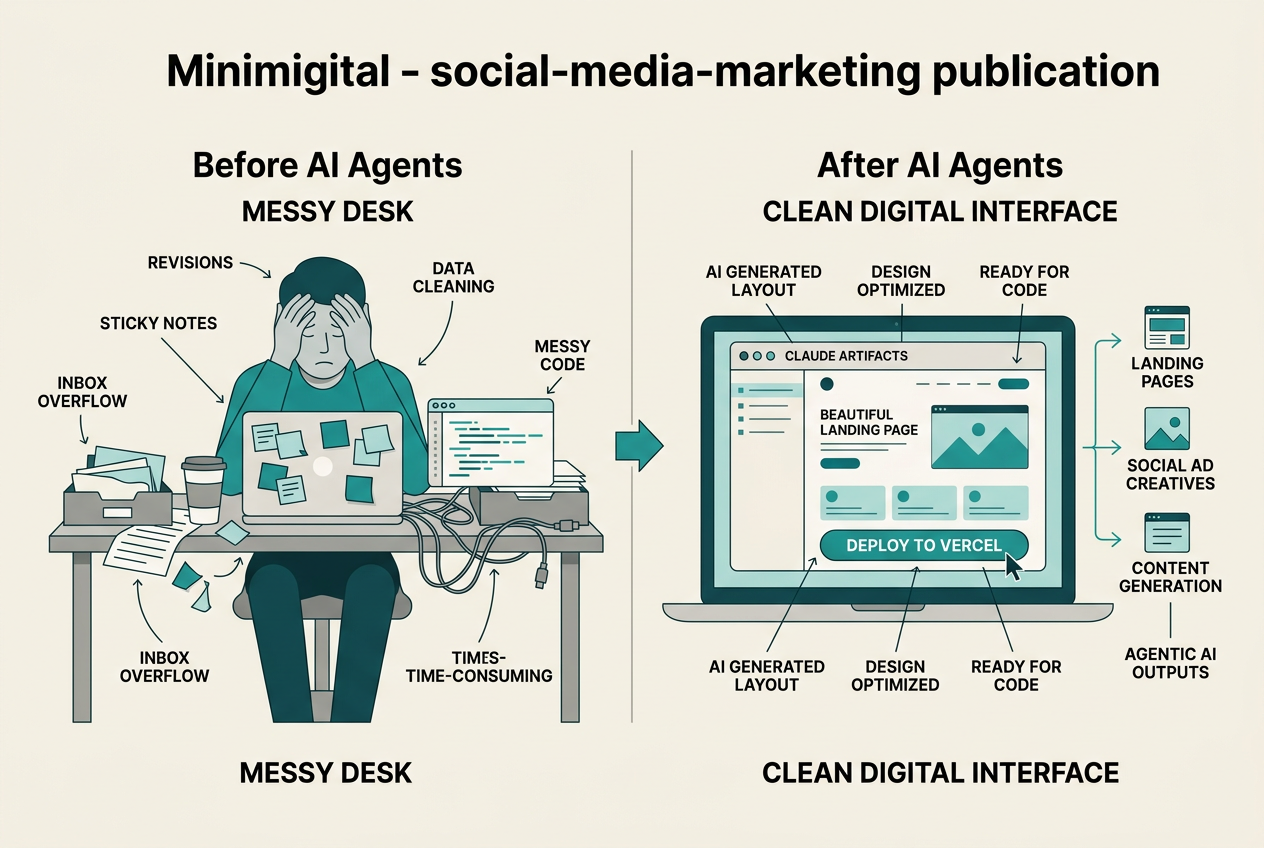
This isn't theory. Per recent discourse in professional marketing circles, strategists are already using Claude to bypass freelancers for technical tasks. One marketer recently noted that Claude could clone a Business Webflow site and create a production version for deployment on Vercel in roughly 10 minutes [S5]. This eliminates the 'technical tax' that usually slows down high-velocity social creative. When you can deploy a new campaign site in minutes rather than days, your ability to react to trending social conversations changes fundamentally.
How AI is reshaping the social media manager role
1. Claude (Anthropic): The Technical Strategist’s Best Friend
If ChatGPT is the creative writer, Claude has become the systems architect. For digital marketers, the standout feature isn't just the prose—it’s the 'Artifacts' UI and the model's superior ability to handle code and structured data.
Claude 3.5 and its successors have proven significantly more reliable for 'one-shot' deployments. In a social media context, this means you can feed Claude a screenshot of a competitor's high-performing landing page and ask it to build a functional clone using your brand's CSS. It doesn't just give you the code; it creates a preview you can interact with. For agencies, this is a massive margin-saver. Instead of hiring a front-end developer for every minor landing page tweak, a social strategist can handle the deployment directly.
Best for: Technical marketing tasks, rapid landing page prototyping, and complex data analysis of social export files.
2. Relay.app: The Multi-Step Workflow Agent
Relay.app represents the next evolution of Zapier. While traditional automation is linear (If This, Then That), Relay introduces 'Human-in-the-loop' agentic workflows. For a social media team, this is the difference between an automated post and a managed campaign.
Imagine a workflow where a new TikTok comment triggers an AI analysis. If the sentiment is 'high intent to buy,' the agent drafts a personalized response, creates a unique discount code in Shopify, and pings a Slack channel for a human to hit 'approve.' This level of nuance was previously impossible without a dedicated community manager. By automating the 'if/then' logic of social engagement, Relay allows small teams to behave like enterprise-level social desks.
Best for: Social teams that need to bridge the gap between engagement and CRM/E-commerce actions without losing the human touch.
3. Creatopy: The High-Velocity Ad Factory
Creatopy has moved beyond being a simple design tool into an agentic creative production platform. For paid social buyers, the bottleneck is rarely the 'big idea'—it’s the 50 different aspect ratios and localized versions required for a global Meta and TikTok rollout.
Their AI agents can take a single master creative and autonomously generate hundreds of variations, adjusting the layout, typography, and even the product placement to fit the specific constraints of Reels, Stories, and YouTube Shorts. This is particularly critical as we see massive investments in TikTok marketing partners. For instance, Youxin Technology’s $10.8 million stake in YATOP [S2] highlights the growing financial weight behind TikTok-centric marketing infrastructure. Tools like Creatopy allow brands to match that scale without a proportional increase in headcount.
Best for: Paid social teams and performance marketers needing to scale creative testing across multiple platforms.
Why creative diversification is the only lever left in Meta Ads
4. Perplexity: The Real-Time Trend Agent
Social media moves faster than a chatbot’s training data. This is where Perplexity shines. Unlike ChatGPT, which may have a knowledge cutoff, Perplexity acts as a research agent that cites its sources in real-time.
For a social strategist, this is the ultimate tool for 'newsjacking.' You can ask, 'What are the three most controversial discussions happening on LinkedIn regarding AI ethics this morning?' and get a cited summary with links to the original posts. This allows for a level of reactive content creation that is grounded in actual data rather than vibes. It’s an essential tool for avoiding the 'out of touch' brand moments that occur when a social team misses a shift in public sentiment or a platform policy change.
Best for: Content strategists and PR leads who need to stay ahead of the 24-hour social news cycle.
5. AdCreative.ai: The Data-Backed Conversion Agent
AdCreative.ai doesn't just make pretty pictures; it uses a massive database of high-converting ad creatives to 'score' your assets before you spend a dollar on them. Its agentic capabilities allow it to take your product URL, scrape the key selling points, and generate ad sets that are mathematically optimized for conversion.
In the post-iOS 14 world, where targeting is broader, the creative has to do the heavy lifting of finding the audience. This tool acts as a pre-flight check for your social ads. It analyzes the contrast, the call-to-action (CTA) placement, and the emotional resonance of the imagery. For brands operating on tight margins, this 'agentic' oversight can reduce the cost-per-acquisition (CPA) by double-digit percentages by weeding out low-performers before they enter the auction.
Best for: E-commerce brands focused on direct-response social advertising and ROAS optimization.
Navigating the risks of automated social systems
While the efficiency gains of agentic AI are undeniable, the risks are scaling just as quickly. We are seeing a rise in 'algorithmic friction' where automated systems collide with platform moderation in ways that can be devastating for users and brands alike.
Consider the recent case where Instagram’s automated systems removed a five-year-old video of a deceased loved one for 'nudity or sexual activity' despite the subject being fully clothed [S3]. This highlights a critical lesson for marketers: as you hand over more power to AI agents, the need for human oversight of the platform's own AI becomes more acute. You cannot set your agentic workflows and walk away.
Furthermore, the geopolitical landscape of 2026 continues to create 'whiplash' for social marketers. With TikTok’s ownership still a point of intense scrutiny and potential divestiture [S4], brands must use agentic AI to remain platform-agnostic. The ability to use a tool like Claude to rapidly port a TikTok-centric strategy over to YouTube Shorts or Instagram Reels isn't just a convenience—it’s a business continuity requirement.
How to implement agentic workflows tomorrow
You don't need a $50,000 enterprise license to start using these agents. Start small. Pick one repetitive, technical task that currently requires a freelancer or a developer.
Try this: Take a screenshot of your best-performing Instagram ad. Feed it into Claude 3.5 Sonnet. Ask it to: '1. Analyze the visual hierarchy. 2. Write the HTML/CSS for a mobile-responsive landing page that matches this aesthetic. 3. Suggest three A/B test variations for the headline based on a 'fear of missing out' (FOMO) psychological trigger.'
You will likely find that the agent completes in five minutes what used to take a two-hour kickoff meeting and three days of back-and-forth emails. This is the 'high-velocity' creative promise. It’s not about replacing the strategist; it’s about removing the friction between the strategy and the execution.
As you integrate these tools, remember that the most valuable skill in 2026 isn't knowing how to write a prompt—it's knowing how to architect a system where multiple AI agents work together to solve a business problem. The marketers who win won't be the ones with the best 'hacks,' but the ones who build the most resilient, automated creative engines.
The rise of the 'AI Architect' in marketing agencies
The future of the social desk
By the end of 2026, the 'social media manager' job description will likely look more like a 'creative technologist.' We are seeing massive consolidation in the industry, such as Youxin's acquisition of YATOP [S2], which signals that the infrastructure of social marketing is becoming increasingly sophisticated and data-driven.
If you are still manually resizing images or struggling to explain a design change to a developer, you are working harder than you need to. The tools are here. The agents are ready. Your job is to stop being the 'doer' and start being the 'director.'
FAQ