The era of the brand mascot as a chaos agent is officially entering its twilight. For three years, Duolingo’s green owl, Duo, defined the 'unhinged' social media playbook—threatening users who missed lessons, simping for pop stars, and engaging in erratic behavior that felt more like a shitposting teenager than a multi-billion dollar ed-tech firm. But as we move through 2026, the joke has curdled. Duolingo is quietly pivoting toward a 'deliberate' marketing framework, signaling that the high-risk, high-reward era of brand nihilism is no longer the North Star for growth.
This isn't just a corporate vibe shift; it's a structural necessity. When every brand from your local insurance broker to a global language app is trying to out-weird each other, 'weird' becomes the new 'boring.' The pivot suggests that while chaos earns impressions, it often fails to build the long-term trust required for high-LTV (lifetime value) subscription models.
The Diminishing Returns of Brand Nihilism
When Duolingo first leaned into the 'toxic owl' persona, it was a masterclass in pattern interruption. In a sea of polished, corporate-speak LinkedIn updates, Duo was a breath of fresh, albeit chaotic, air. It worked because it was unexpected. Fast forward to mid-2026, and the landscape is unrecognizable. Per recent Digiday reporting on the 'TikTok whiplash' of 2026, marketers are finding that low-fidelity, high-chaos content is suffering from extreme fatigue The shift in TikTok organic reach.
The math on 'unhinged' content has changed. Initially, the engagement-to-risk ratio was heavily weighted in favor of the brands. You could post a slightly edgy meme, get a million views, and only risk a few angry emails to the PR department. Today, the stakes are higher. Platforms are more volatile, and audience sentiment can turn on a dime. We’ve seen this with the recent ownership issues at X, where brand safety has become a moving target [S4]. For Duolingo, maintaining a persona that thrives on being 'problematic' is a liability when you're trying to convince parents and schools that you are a serious educational tool.
From Viral Hits to Deliberate Retention
Duolingo’s new stance focuses on what internal teams are calling 'deliberate' marketing. This doesn't mean they are returning to stock photos of smiling people holding tablets. Instead, it means every piece of content must serve a specific stage of the funnel beyond just 'awareness.'
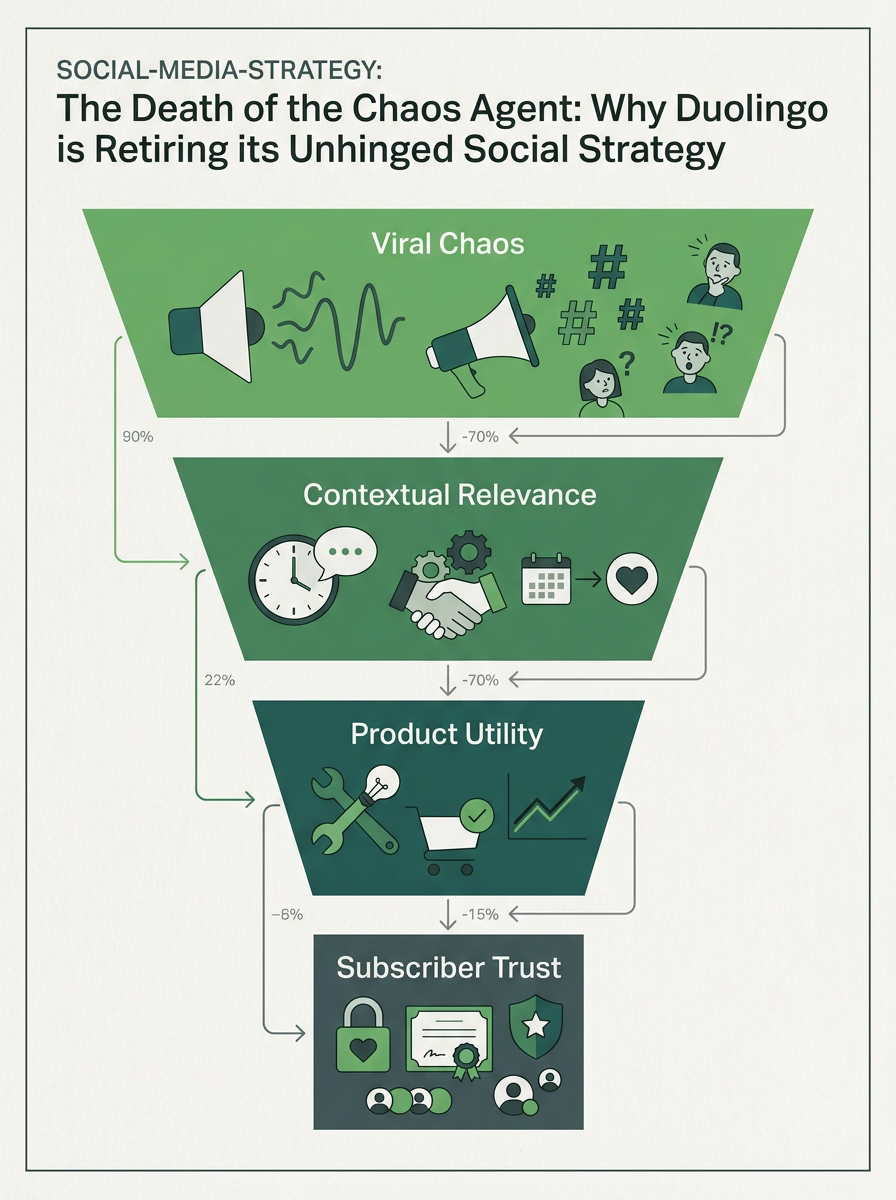
In the old playbook, a video of Duo twerking to a trending sound was a win if it hit 5 million views. In the new playbook, that video is a failure if it doesn't correlate with an uptick in 'streak' retention or a decrease in churn. The agency world is already feeling this shift. Take the recent $10.8 million acquisition of an 18% stake in TikTok partner YATOP by Youxin Technology [S2]. This kind of consolidation suggests that the big players are looking for data-backed, scalable TikTok strategies—not just lightning-in-a-bottle viral moments.
If you're managing a brand in 2026, you've likely noticed that the 'algorithm' is less interested in your mascot's personality and more interested in the utility of your content. Whether it's using AI tools like Claude to rapidly iterate on landing pages or using specialized agents to manage customer service [S5], the focus has moved from attention to automation and attribution.
The 'Safe-Unhinged' Middle Ground
Is the unhinged voice dead? Not entirely, but it has evolved into what I call 'Safe-Unhinged.' This is a curated version of chaos that feels spontaneous but is actually vetted by three layers of legal and a diversity consultant. It’s the difference between a comedian doing crowd work and a scripted sitcom that looks like a documentary.
Brands like Ryanair and Scrub Daddy are still leaning into the bit, but even they have tightened the guardrails. The reason is simple: the platforms themselves are becoming more hostile to creators and brands alike. We see stories of users losing years of sentimental content due to aggressive, automated moderation [S3]. When the platforms are this unpredictable, a brand voice that is intentionally provocative is like smoking in a fireworks factory. One misunderstood joke and your entire organic reach—built over half a decade—can be throttled or deleted by an AI moderator that doesn't understand irony.
Why the 'Chaos Agent' Fails in a Saturated Market
The problem with the chaos agent strategy is that it has no floor. To stay relevant, you have to keep raising the stakes. If Duo was 'unhinged' by stalking users in 2023, what does he have to do in 2026 to get the same reaction? The trajectory leads to a place where no sane CMO wants to go.
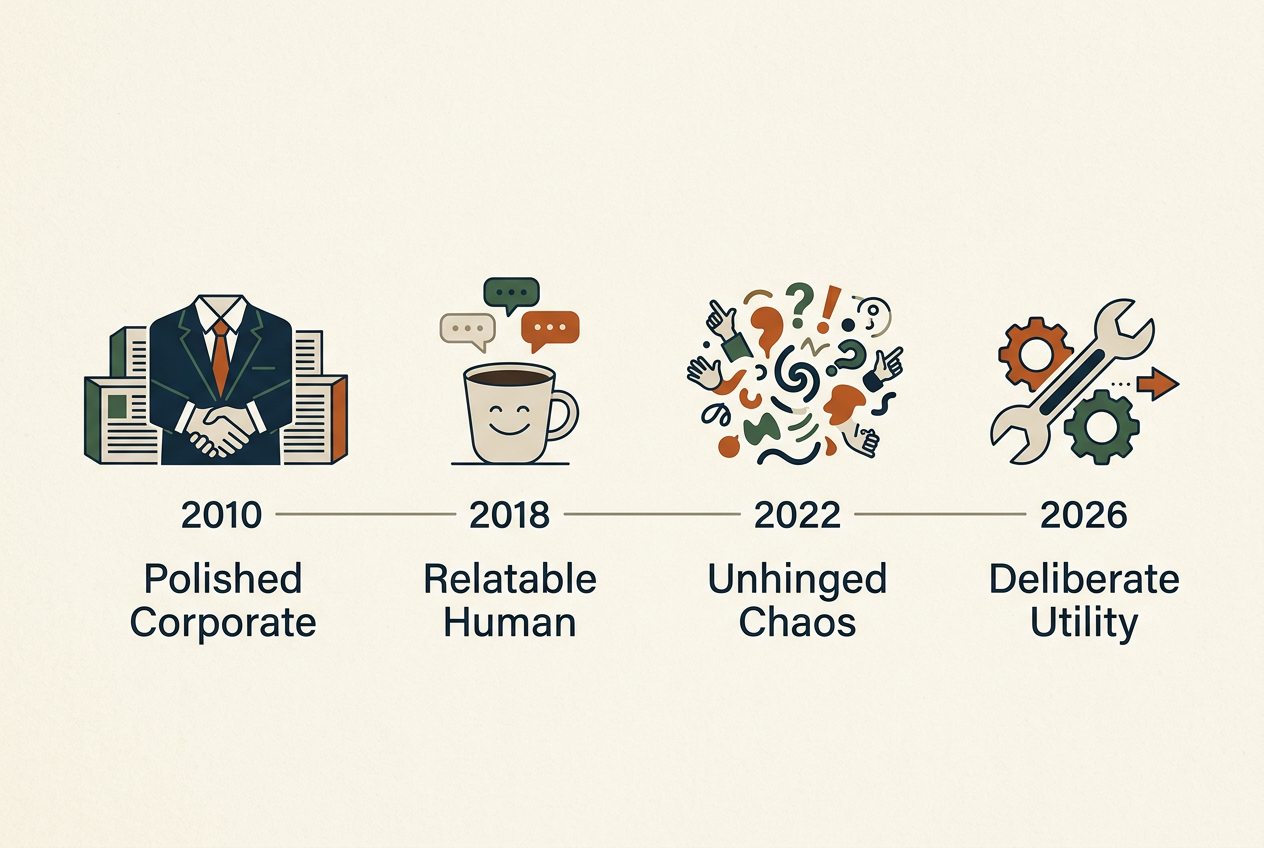
Moreover, the rise of AI-generated content has made the 'weird' and 'surreal' incredibly cheap to produce. When a user can use a tool to generate a video of any mascot doing anything in ten minutes, the brand's own 'unhinged' content loses its specialness. We are seeing a return to 'human-centric' or 'process-led' content. People want to see the humans behind the owl, not just the owl acting like a human with a personality disorder.
Refuting the Counterargument: 'But Engagement is Everything'
The loudest critics of this pivot will point to the raw numbers. They’ll say, 'Duo’s unhinged posts still get 10x the engagement of their educational posts.' And they are right. But engagement is a vanity metric if it doesn't lead to brand equity.
There is a phenomenon I call 'The Mascot Trap.' It’s when your audience falls in love with the character but has zero affinity for the product. If people follow Duolingo for the owl’s antics but haven't opened the app to learn Spanish in six months, that follower is a cost, not an asset. By pivoting to 'deliberate' marketing, Duolingo is betting that a smaller, more focused audience of actual learners is more valuable than a massive audience of meme-watchers.
What This Means for Your 2026 Social Strategy
If you’ve been trying to convince your boss to let your brand mascot 'go wild' on TikTok, you might have missed the boat. The window for being the 'first' unhinged brand in your category has closed. Instead, focus on these three pillars of the post-unhinged era:
- Utility-First Creative: Does this content help the user solve a problem, or just entertain them for three seconds?
- Radical Transparency: Use the 'human' element. Show the production, the failures, and the real people. AI can do 'weird' better than you, but it can't do 'real.'
- Platform Resilience: Don't build your entire brand identity on the back of a single persona that could be banned or 'canceled' tomorrow.

We are moving toward a more mature version of social media marketing. One where the goal isn't to break the internet, but to build a sustainable bridge to the consumer. Duolingo’s pivot is the first major domino to fall. Expect others to follow suit as the 2026 fiscal year forces a move from 'vibes' to 'value.'
The Prediction: The Great Mascot Retraction
By the end of 2027, the 'unhinged' brand voice will be viewed with the same cringe we now reserve for the 'Corporate Memphis' illustration style of the late 2010s. We will see a massive 'de-personalization' of brand accounts. The mascots won't disappear, but they will return to their roles as spokespeople rather than protagonists.
Mark my words: the next big 'viral' brand won't be the one that makes the funniest jokes, but the one that provides the most seamless, invisible utility in a world cluttered with AI noise. The owl is putting down the knife and picking up the textbook. You should probably do the same.
FAQ