Instagram has officially closed the door on the 'curation as a service' era. If your brand’s growth strategy relies on reposting viral clips, unedited User-Generated Content (UGC), or cross-posting Reels from TikTok without significant changes, you are likely seeing reach figures that look like a flatline.
Why? Because Adam Mosseri’s team has deployed a sophisticated 'originality filter' designed to prioritize the source over the megaphone. The platform is no longer just looking for watermarks; it is looking for the digital fingerprint of the file itself. For practitioners, this isn't just a minor algorithm tweak—it is a fundamental shift in how the feed is built.
TL;DR
- The Originality Filter: Instagram now identifies duplicate content at the pixel level, replacing reposts with the original creator's post in Recommendations.
- Aggregator Penalty: Accounts that primarily post content they didn't create will be removed from Recommendation surfaces (Explore, Reels tab) for 30 days.
- The 'Significant Value' Rule: To avoid being flagged, you must add 'material' changes, such as voiceovers, heavy editing, or transformative commentary.
- UGC Shift: Brands must now license and 'remix' UGC rather than simply reposting the raw asset.
The technical mechanism behind the duplicate content filter
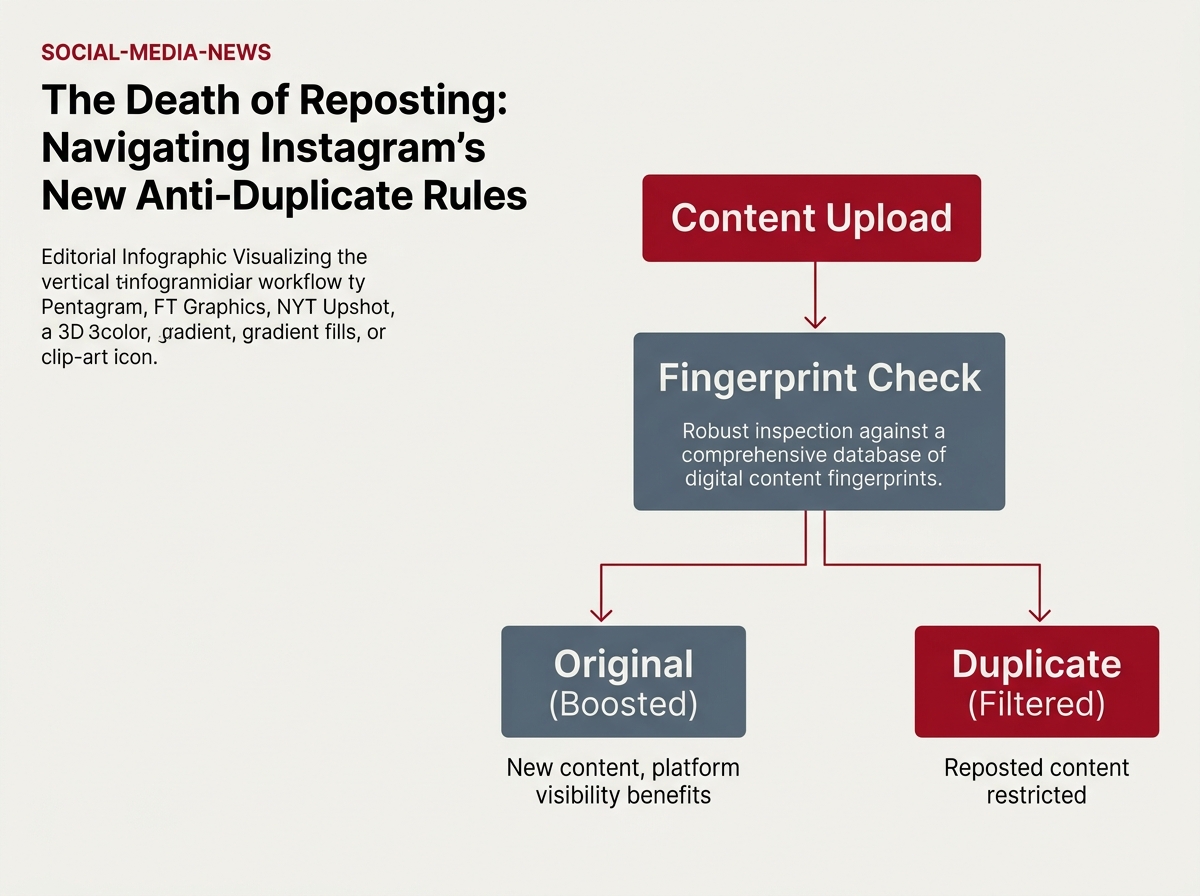
To understand how to beat the filter, you have to understand how it identifies you. Instagram isn't just looking for the TikTok logo anymore. They are using hash-matching and visual fingerprinting to identify when the same video sequence appears across multiple handles.
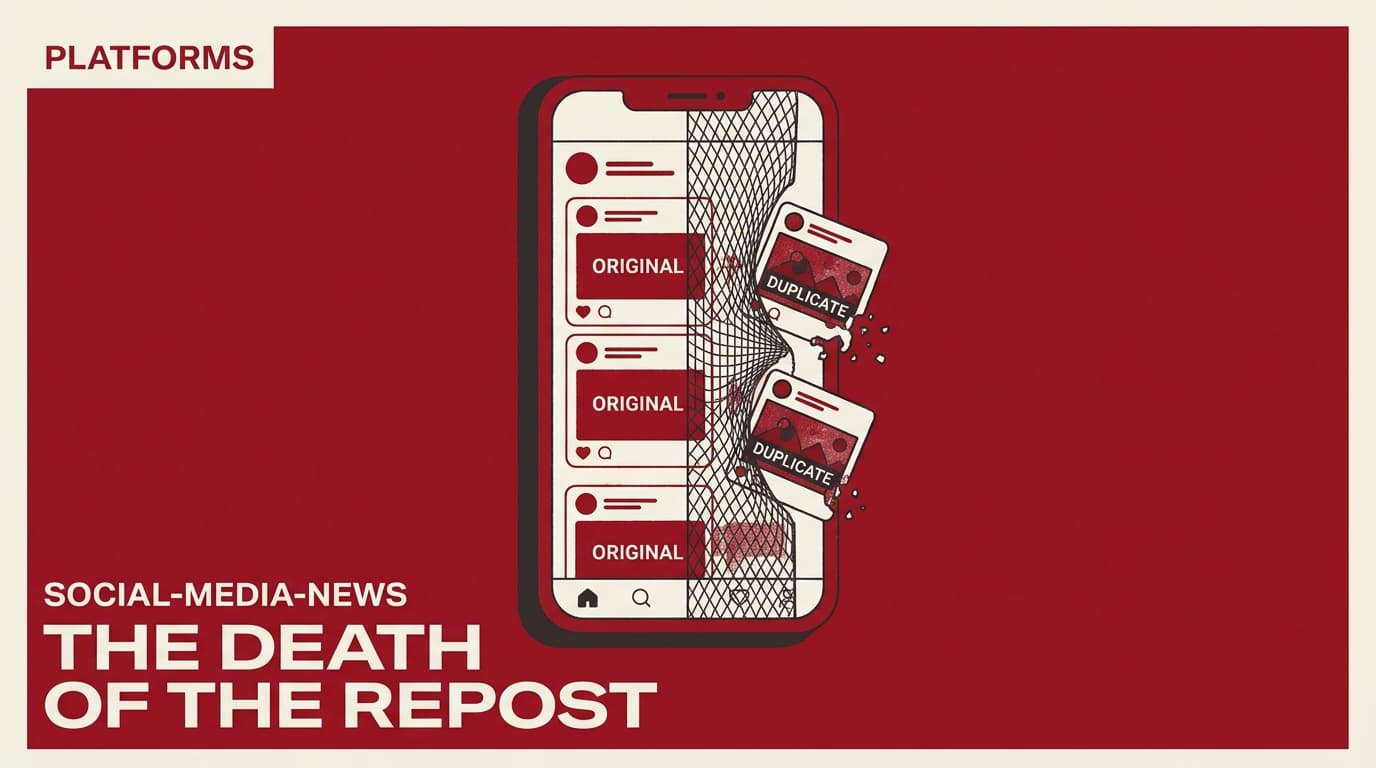
When you upload a video, Instagram’s AI compares it against a massive database of existing content. If it finds a match with an earlier upload, the system makes a choice. Instead of showing your version to a cold audience in the Reels tab, it swaps your post for the original creator’s version. You keep the post on your profile, and your followers might see it, but you've essentially lost all discovery potential.
This is a direct response to the 'aggregator' economy—those accounts with millions of followers that do nothing but scrape viral videos and repost them. By late 2025, internal Meta data suggested that unoriginal content accounted for a double-digit percentage of Reels impressions, frustrating the creators who actually spent the time and money to produce the work. Following the trend of TikTok's own shift—noted by the recent $10.8 million investment by Youxin Technology into TikTok partner YATOP [S2]—platforms are moving toward a model where 'ownership' of the asset is the primary currency of reach.
Why your UGC strategy is currently breaking
For years, the standard brand playbook was simple: find a customer-made video, ask for permission (hopefully), and repost it to the brand's main feed. This was the gold standard for 'social proof'.
Today, that same tactic is a liability. If a creator posts a video on Monday and your brand reposts the exact same file on Tuesday, Instagram’s filter flags your post as 'unoriginal'. Since you are the second uploader, the algorithm suppresses your reach and gives the 'recommendation' credit to the creator.
This creates a paradox for social media managers. You want the authenticity of UGC, but the platform is punishing the distribution of it. The solution isn't to stop using UGC; it's to stop reposting it. You must become a collaborator rather than a mirror. This means using the 'Collabs' feature or, more effectively, taking the raw footage and editing it into a brand-new narrative structure.
How to secure usage rights for UGC without killing the vibe
The 30-day recommendation ban: The stakes of non-compliance
Instagram isn't just filtering individual posts; they are monitoring account behavior. If an account posts 'unoriginal' content 10 or more times within a rolling 30-day window, the entire account is hit with a recommendation ban.
This is the 'shadowban' made official. For 30 days, none of your content—even the original stuff—will appear on the Explore page or the Reels feed. You are effectively locked in a room with only your existing followers. For brands trying to acquire new customers, this is a death sentence for monthly KPIs.
We saw similar volatility on X (formerly Twitter) throughout 2025 and 2026 as ownership and moderation rules shifted, causing brands to brace for 'whiplash' [S5]. Instagram's move is more predictable but no less punishing. The only way to lift the ban is to stop the reposting behavior and wait out the 30-day cooling-off period. You can check your 'Account Status' in the settings menu to see if you've been flagged, but by then, the damage to your engagement rate is usually already done.
Defining 'Significant Value' in an AI-driven feed
So, what counts as 'original'? Instagram’s guidelines are intentionally vague, but we can look at the cues they've given to marketers. To pass the filter, your content must add 'significant value'.
Writing a new caption isn't enough. Adding a 'Link in Bio' sticker isn't enough. In fact, even simple reaction videos (the 'split screen' style) are being scrutinized more heavily. To be considered original, the new asset needs to be a 'transformative' work.
Think about how marketers are using new AI tools like Claude to rebuild entire web infrastructures [S4]. That same level of 'agentic' transformation is what the algorithm wants to see in video. This includes:
- New Voiceover: Replacing the original audio with a brand-specific narrative.
- Heavy Intercutting: Using the UGC as B-roll rather than the primary footage.
- Educational Overlays: Adding significant on-screen text that changes the context of the video (e.g., a tutorial or a deep-dive analysis).
If the AI can still recognize the 'core' of the video as a duplicate of a high-performing post, you are at risk. The goal is to make the asset unrecognizable to a pixel-matching algorithm while remaining recognizable to a human audience.
The 'Singing Girl' Problem: When AI moderation goes wrong
There is a human cost to these aggressive filters. Automated systems often lack the nuance to distinguish between a 'repost' and a 'memory'. We've seen instances where the system flags content for 'nudity' or 'sexual activity' that is entirely innocent, such as a video of a deceased partner singing [S3].
For brands, this means that even if you aren't 'reposting' in the traditional sense, you might get caught in the crossfire of an over-zealous AI moderator. If you are uploading historical brand assets or old campaign footage, the system might flag it as 'unoriginal' because it exists elsewhere on the web.
To mitigate this, always ensure your uploads are the highest possible bitrate and, where possible, include metadata that proves your account is the source. Avoid using 'stock' video backgrounds that have been used by thousands of other creators, as these are easy triggers for the duplicate filter.
How to modify your social workflow tomorrow
If you've been relying on a 'curate and share' model, your workflow needs an immediate overhaul. You cannot simply 'pivot'—you have to rebuild the engine.
1. Audit your current feed. Look at your last 30 days of content. How many of those posts were raw UGC or shared from other platforms? If it's more than five, you are in the danger zone.
2. Shift to 'Collabs' only. When working with influencers, do not ask them to send you the file to post. Use the Instagram Collab tool. This ensures both accounts are credited as 'original' and the views are consolidated rather than split.
3. Invest in 'Transformative' editing. If you must use a third-party clip, treat it as raw material. Change the color grade, add a new soundtrack, and overlay a host who provides commentary. The 'Reaction' format is still viable, but it needs to be more than just a person nodding at a screen.
4. Monitor 'Account Status' daily. This should be part of every Social Media Manager's morning routine. If you see a violation, appeal it immediately with proof of licensing, but more importantly, delete the offending post to prevent a 30-day ban.
The 2026 guide to Instagram Reels SEO
The future of the 'Originality First' algorithm
Instagram’s shift is part of a broader industry trend toward 'walled gardens'. As AI makes it easier to generate and replicate content, platforms are desperate to protect the creators who provide the unique 'human' element. They want to be a destination for new ideas, not a mirror of TikTok.
For brands, this means the 'low-effort' era of social media is over. You can no longer win by being the loudest person in the room with someone else's megaphone. You have to be the source. Whether that means hiring in-house creators or doubling down on high-production original series, the mandate is clear: be original, or be invisible.

As we look toward the rest of 2026, expect these filters to become even more granular. We may see a time where even 'similar' scripts or 'trending' audio are de-prioritized in favor of truly unique audio-visual signatures. The brands that win will be those that stop chasing trends and start setting them.
FAQ