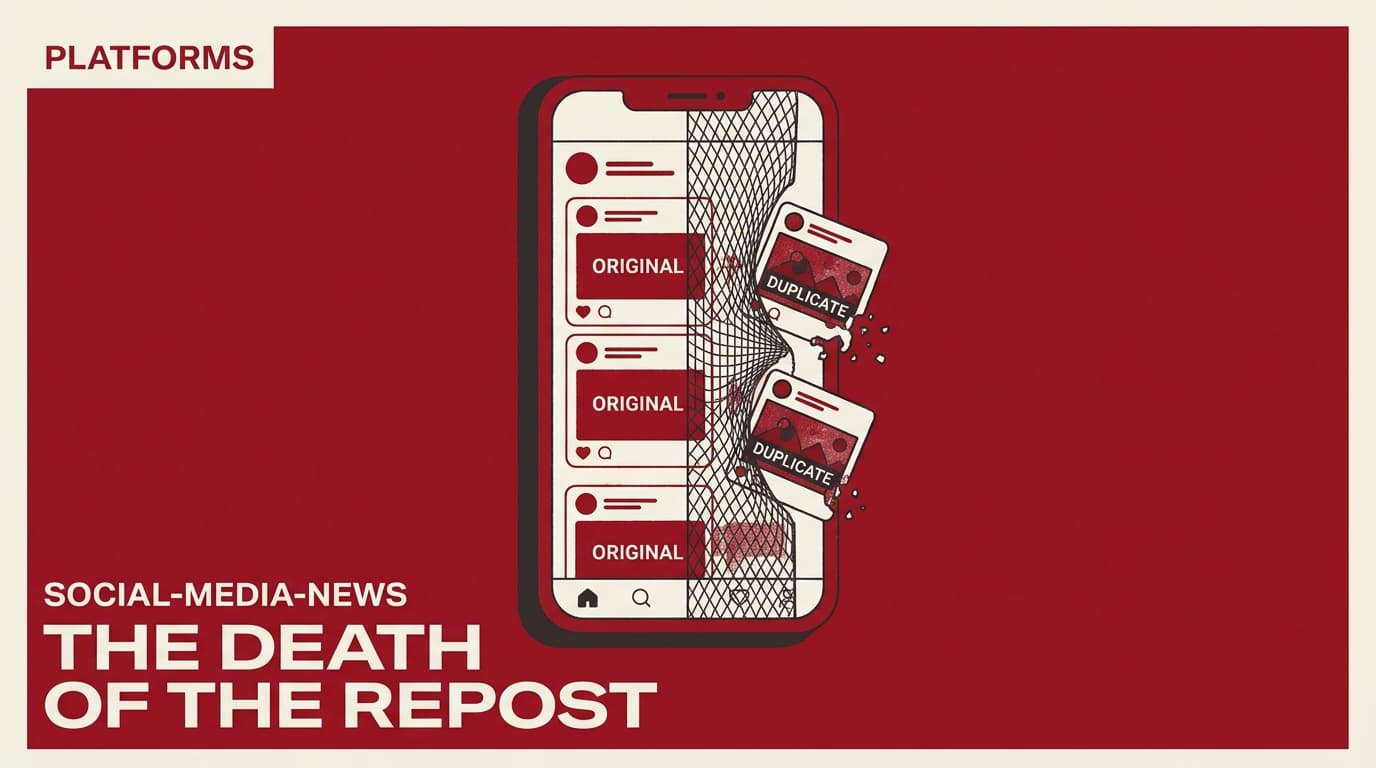
Why did my reach drop overnight? It is the question currently echoing across Slack channels and creator Discords as the Instagram algorithm update 2025 rolls out its most aggressive enforcement of original content ranking to date. If you are running an account that relies on 'curating' clips, re-posting viral TikToks, or building a brand around faceless aggregation, you aren't just fighting for attention anymore—you are fighting the system itself.
For years, the arbitrage of content was a viable business model. You find a trending video, add a text overlay or a reaction, and ride the wave of the platform's recommendation engine. Those days are ending. Instagram's latest technical shift is designed to ensure that the person who pressed 'record' is the one who gets the reach. This isn't just a slap on the wrist; it is a structural demolition of the aggregator economy.
TL;DR
- Originality is the primary signal: Instagram now actively swaps out duplicate content for the original version in recommendations.
- Aggregator penalties: Accounts that repeatedly post unoriginal content found elsewhere on the platform will be removed from the 'Explore' page and 'Reels' tab recommendations for 30 days.
- Faceless brands must pivot: Pure curation is no longer a growth strategy. You must add 'significant creative value' to avoid being flagged as a duplicate.
The Mechanism of the Duplicate Content Penalty
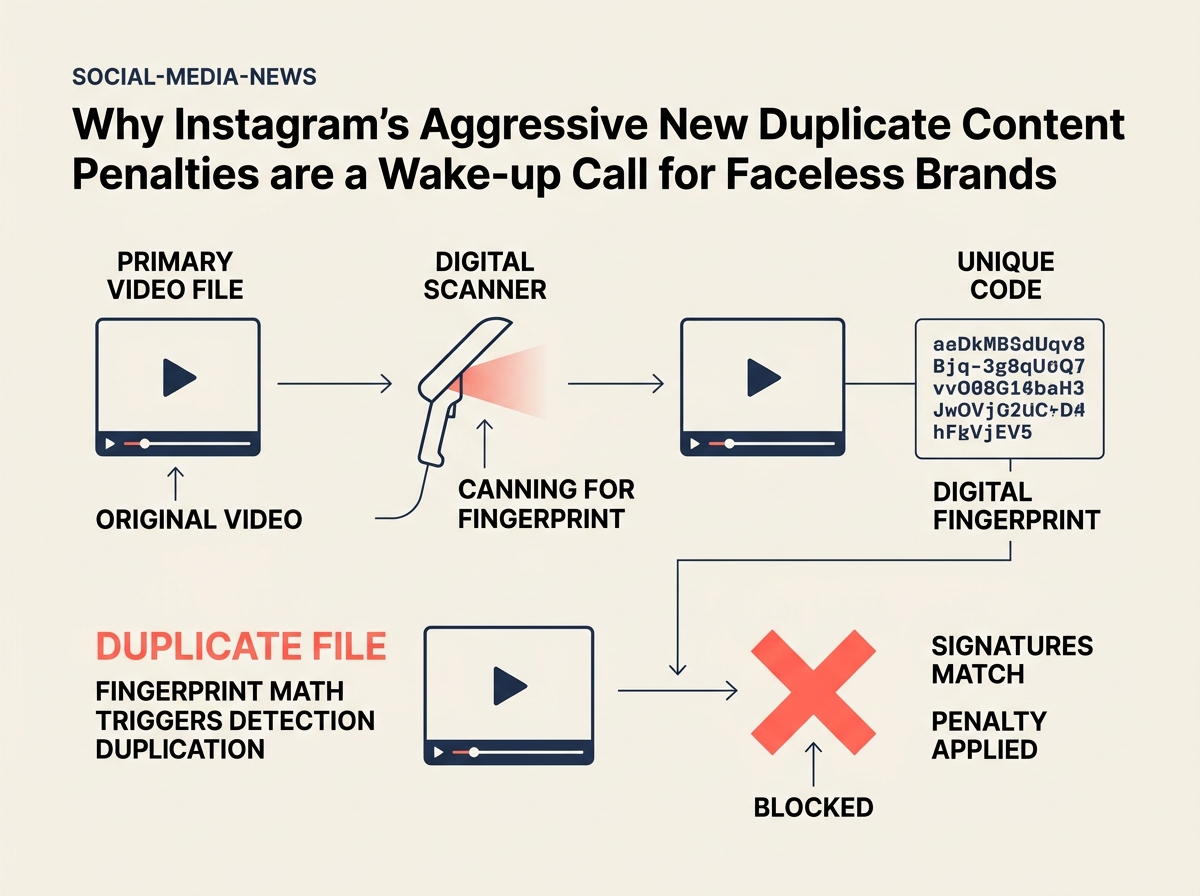
To understand why your views might be cratering, you have to understand the 'fingerprinting' technology Instagram is now deploying. Every piece of media uploaded to Meta’s ecosystem is assigned a unique digital signature. When you download a video from TikTok and re-upload it to Instagram, the algorithm doesn't just see pixels; it sees a match to an existing signature already in its database.
In the past, Instagram merely gave a slight 'ranking boost' to original posters. Now, the platform uses a replacement mechanism. If the algorithm detects that a Reel is a duplicate of an existing post, it will identify the original version and recommend that one instead of yours. This happens silently. You won't get a notification that you've been swapped; you'll just see your reach stall at zero.
This is a massive shift from the 'free-for-all' era of 2021-2023. Aggregator accounts—often called 'theme pages' or 'faceless brands'—that grew by millions by simply being faster at re-posting viral content are seeing their distribution pipelines severed. Per internal Meta data shared in late 2024, the goal is to shift the 'share of voice' back to primary creators by at least 25% across the Reels tab.
Why Curated UGC is Becoming a Liability
Many brand marketing leads have leaned heavily on User Generated Content (UGC). The strategy was simple: find customers talking about your product, download their clips, and post them to the brand's main feed. Under the new rules, this is a dangerous game. If the customer has already posted that video to their own profile, your brand's post is technically a duplicate.
How to navigate the shift to original UGC
When you re-post a customer's video without making 'significant' changes, you risk your account being flagged as an aggregator. Instagram defines an aggregator as any account that posts content it didn't create or significantly enhance more than 10 times in a 30-day window. Once you hit that threshold, the platform can remove your entire account from recommendation surfaces. This means your content will only be shown to your existing followers—and even then, it may be deprioritized in their feeds.
This creates a paradox for faceless brands. The very thing that made them efficient—not having to produce high-budget original shoots—is now the thing that makes them invisible. You can't just be a middleman anymore. You have to be an editor, a commentator, or a director.
The Definition of Significant Creative Value
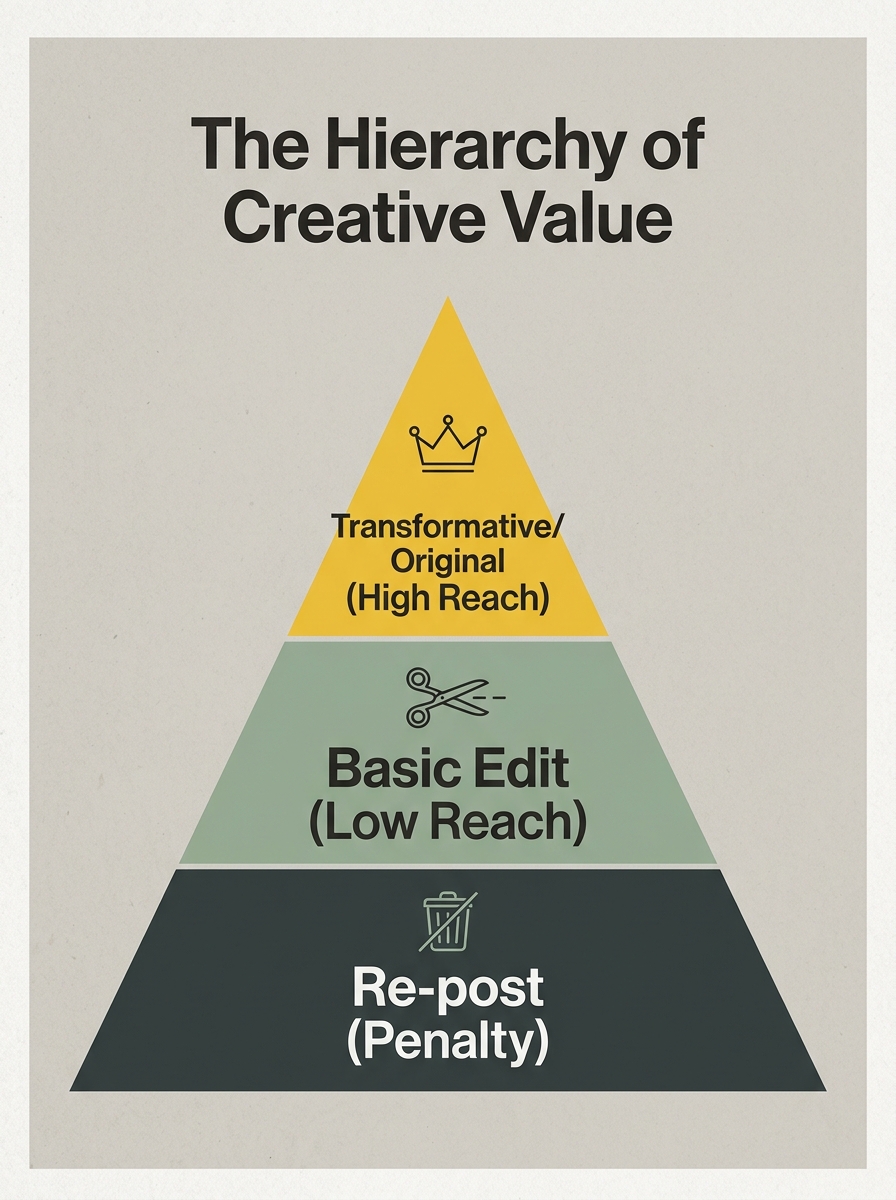
So, what counts as 'original'? This is where the nuance of Instagram SEO and ranking comes into play. Instagram’s engineers have clarified that 'significant' changes are required to bypass the duplicate filter. Simply adding a caption or a background music track isn't enough.
We are seeing the algorithm reward content that uses 'Remix' features or adds a heavy layer of editorialization. If you are a brand using UGC, you should be doing more than just re-uploading. You need to be stitching, reacting, or providing a voiceover that adds a new perspective. The AI-driven moderation tools are now sophisticated enough to distinguish between a 'low-effort' edit and a 'transformative' one.
Think of it like the 'Fair Use' doctrine in copyright law, but enforced by a machine with no sense of humor. If the machine decides your video is 90% identical to one that already exists, you lose. This is particularly relevant given the rise of AI tools. While tools like Claude can help you script or even code websites in minutes [S5], using AI to simply 'spin' existing video content is a recipe for a shadowban. The algorithm is looking for human-centric signals that indicate a new creative work has been birthed.
The Impact on Faceless Brands and Theme Pages
Faceless brands—accounts focused on niches like 'luxury lifestyle,' 'motivation,' or 'travel tips' without a central personality—are in the crosshairs. These accounts have historically been the biggest offenders in the duplicate content space. For a strategist, this means the 'low-cost, high-volume' playbook is dead.
We are seeing a divergence in the market. On one hand, you have 'active' faceless brands that use stock footage (licensed and unique) combined with high-quality original voiceovers and motion graphics. These accounts are still thriving because their digital fingerprints are unique. On the other hand, you have 'passive' aggregators who scrape content from Pinterest or TikTok. These accounts are seeing 70-90% drops in Explore page traffic since the January update.
The rise of the 'Active Faceless' brand model
This shift also mirrors broader industry anxiety. Just as marketers are bracing for 'TikTok whiplash' due to potential ownership changes in 2026 [S4], the stability of Instagram as a distribution channel for non-original content is evaporating. You cannot build a long-term business on rented assets that the landlord is now actively trying to delete.
How to Audit Your Distribution Strategy
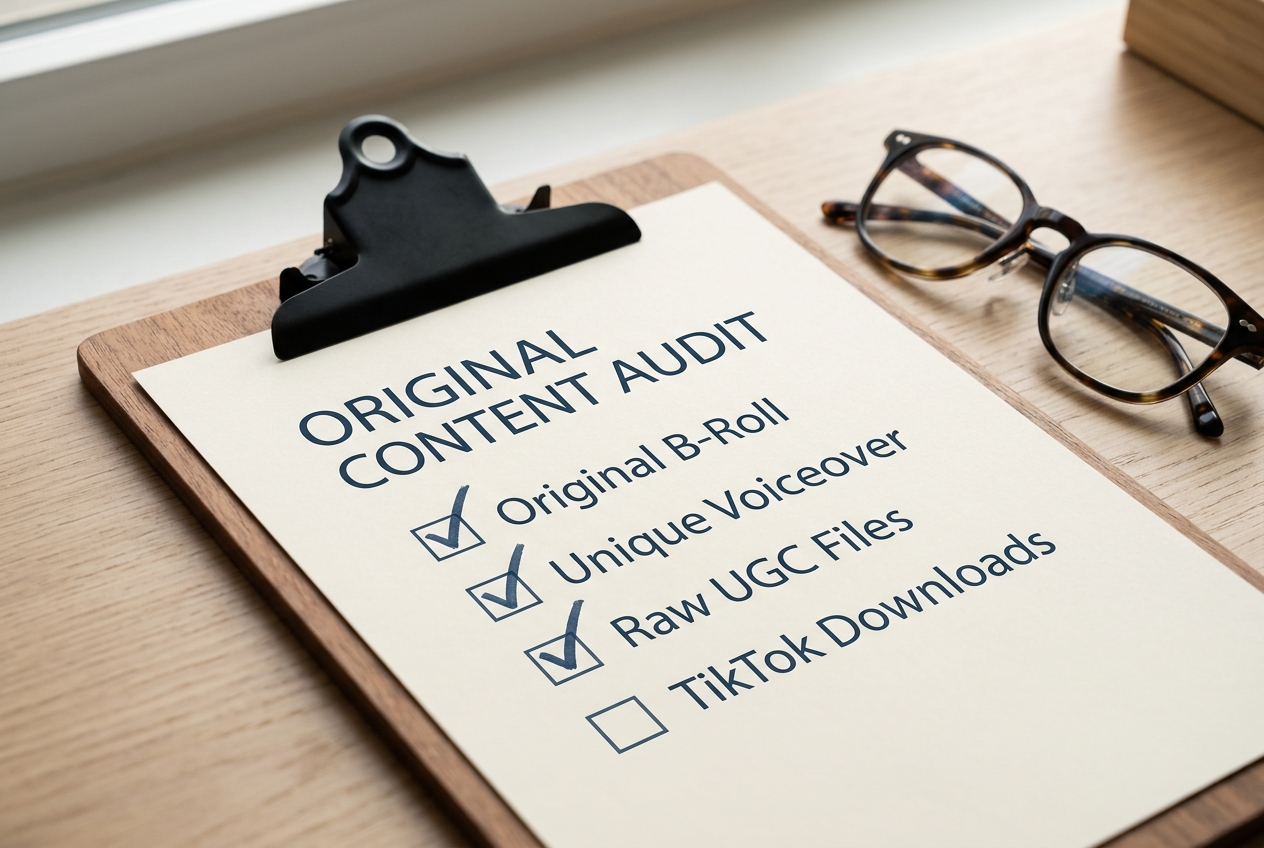
If you've seen a dip in reach, your first step is a content audit. You need to look at your last 30 days of posts through the lens of a platform engineer. How much of this could be found elsewhere?
- Check your 'Account Status': Instagram has made this more transparent. Go to your professional dashboard and look for 'Recommendation Guidelines.' If you've been flagged for unoriginal content, it will often show up here with a countdown until your eligibility is restored.
- Stop the 'Save and Re-post' Workflow: If you are using third-party tools to download Reels without watermarks, stop. The metadata and visual fingerprinting will still catch you.
- Pivot to 'Original First' UGC: Instead of asking creators for permission to re-post their existing videos, ask them to send you the raw files so you can edit a unique version for your brand page. This ensures your post has a unique signature.
- Invest in Proprietary Assets: This might mean hiring a creator to be the 'face' of the brand or investing in high-end 3D animation. Anything that cannot be easily replicated by a scraper.
What This Means for the Future of Instagram SEO
Instagram SEO is no longer just about keywords and hashtags; it is about 'provenance.' The algorithm wants to know where a piece of content started. In 2025, the most important SEO signal you can send to Instagram is that you are the source.
We are entering an era of 'Verified Originality.' For brand leads, this means the era of the 'Social Media Manager as Curator' is over. The new role is 'Social Media Manager as Producer.' You need to be creating, not just collecting. The platforms are tired of being a hall of mirrors where the same five viral clips bounce around forever. They want fresh, high-retention content that keeps users on the app. If you can't provide that, they'll find someone who can—and they'll give your reach to them.
This isn't just about avoiding penalties; it's about competitive advantage. While your competitors are getting throttled for re-posting the same trending audio and clips, your commitment to original production will give you a 'clean' account status. In a world of duplicates, the original is king.
Why provenance is the new SEO gold standard
Final Actions for Brand Strategists
Don't wait for a 30-day recommendation ban to change your habits. The trend line is clear: Meta is prioritizing the 'Creator' in 'Content Creator.' If you are a brand, you must act like a creator. This means moving away from the 'faceless' aesthetic if it relies on stolen or shared footage. Build a library of proprietary B-roll. Create a signature editing style that AI can't easily mimic. Most importantly, focus on the 'Social' in social media—real people, real voices, and original stories will always outrank a re-post, no matter how viral the original was.
The 'wake-up call' has been delivered. Whether you answer it or hit snooze will determine your brand's visibility for the rest of the year. The algorithm is no longer a neutral arbiter of quality; it is a gatekeeper of originality. Make sure you have the keys.
FAQ